Welcome: HIGROWSIR

In 2026, driven by high energy volatility across Europe and Eastern Europe, commercial glasshouses are increasingly replacing traditional High-Pressure Sodium (HPS) lamps with high-power 1000W to 1500W LED top-lighting to reduce operational costs. However, implementing single fixtures with high photon output (such as 5850 μmol/s) introduces specific thermodynamic and optical variables.
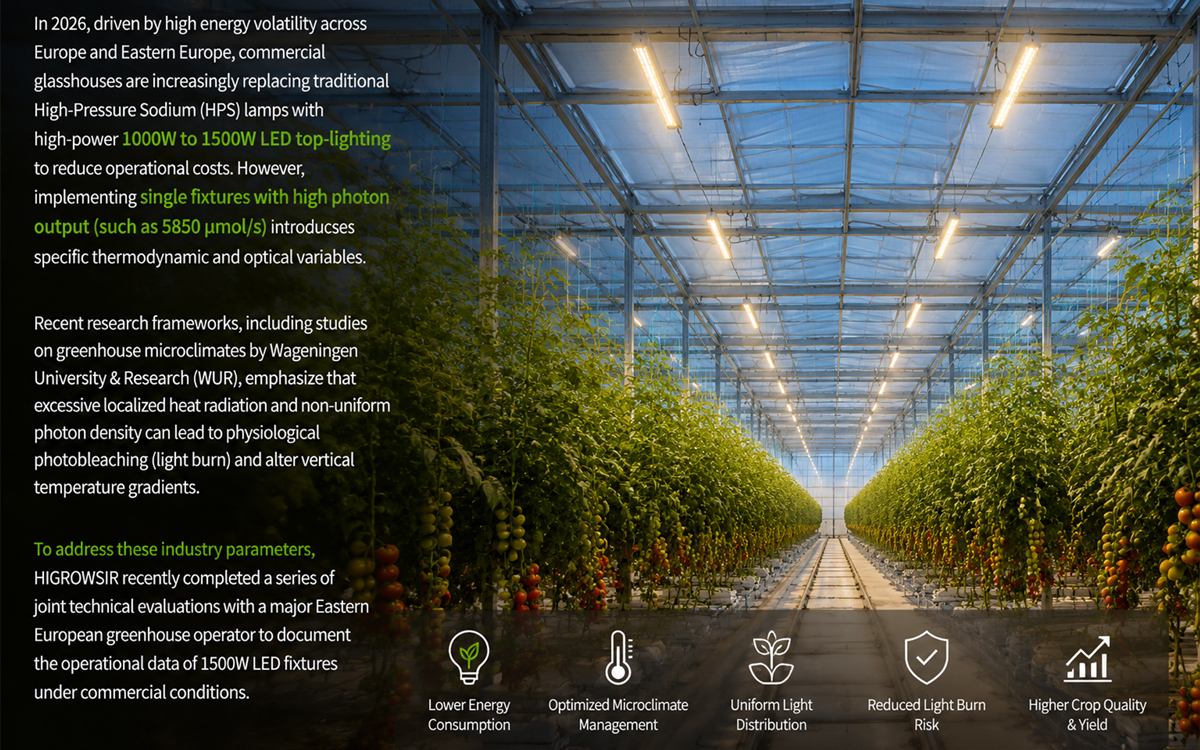
Recent research frameworks, including studies on greenhouse microclimates by Wageningen University & Research (WUR), emphasize that excessive localized heat radiation and non-uniform photon density can lead to physiological photobleaching (light burn) and alter vertical temperature gradients. To address these industry parameters, HIGROWSIR recently completed a series of joint technical evaluations with a major Eastern European greenhouse operator to document the operational data of 1500W LED fixtures under commercial conditions.
In high-latitude glasshouses during winter, the surface temperature of top-lighting fixtures directly affects the upper air boundary layer. If a fixture radiates excessive infrared heat downward, it can cause localized overwarming at the crop's apical meristems (growth points) and potentially induce condensation on the glass roof as warm air rises—a known risk factor for fungal pathogens like Botrytis.
The joint evaluation tracked the thermal stabilization of the HIGROWSIR 1500W fixture. In a controlled ambient temperature of 25°C, the fixture was operated at 100% continuous power for 60 minutes. Data logged via thermal sensors showed the average equilibrium temperature across the finned aluminum passive heat sink stabilized at 70°C.
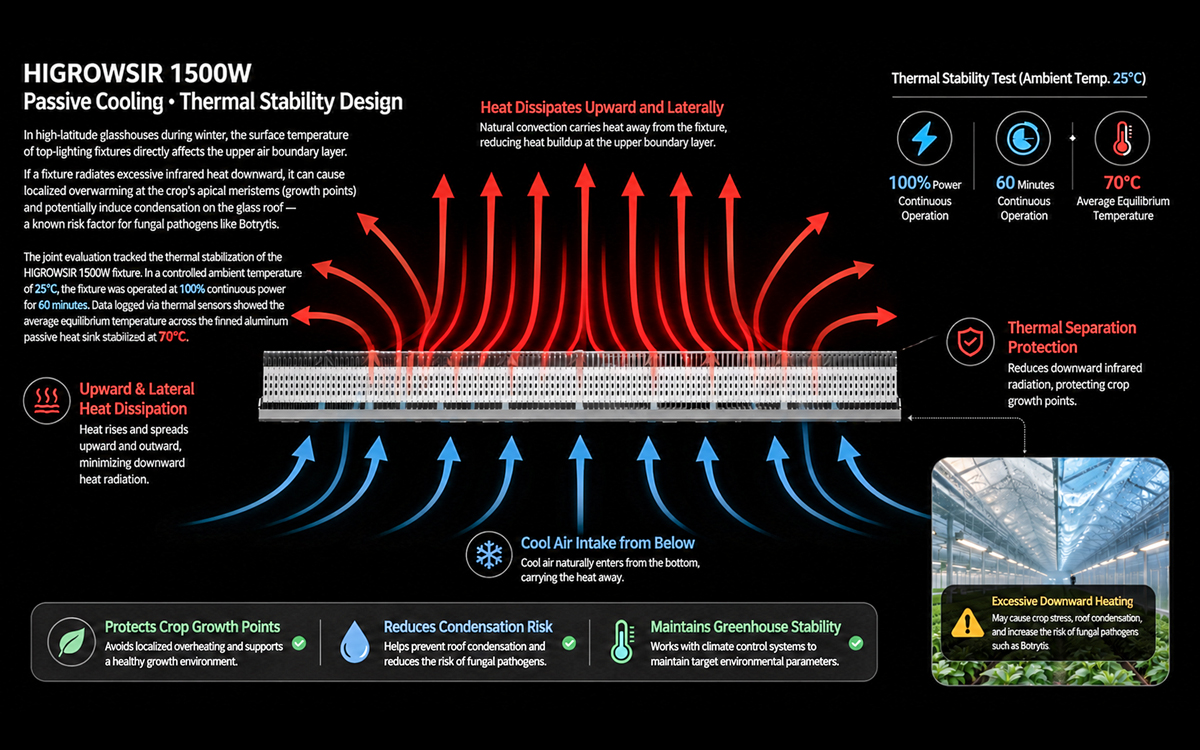
The structured fins utilize natural air buoyancy to guide heat dissipation vertically upwards and laterally, separating the fixture’s convective heat from the downward photon path. This thermal profile helps maintaining the ambient temperature parameters established by the greenhouse climate computer.
Achieving a high total output of 5850 μmol/s requires precise beam shaping to prevent localized photon stress. According to horticultural lighting standards, a concentrated light pattern creates "hotspots" directly under the lamp axis, where photon intensity exceeds the crop's light saturation point, causing photobleaching.
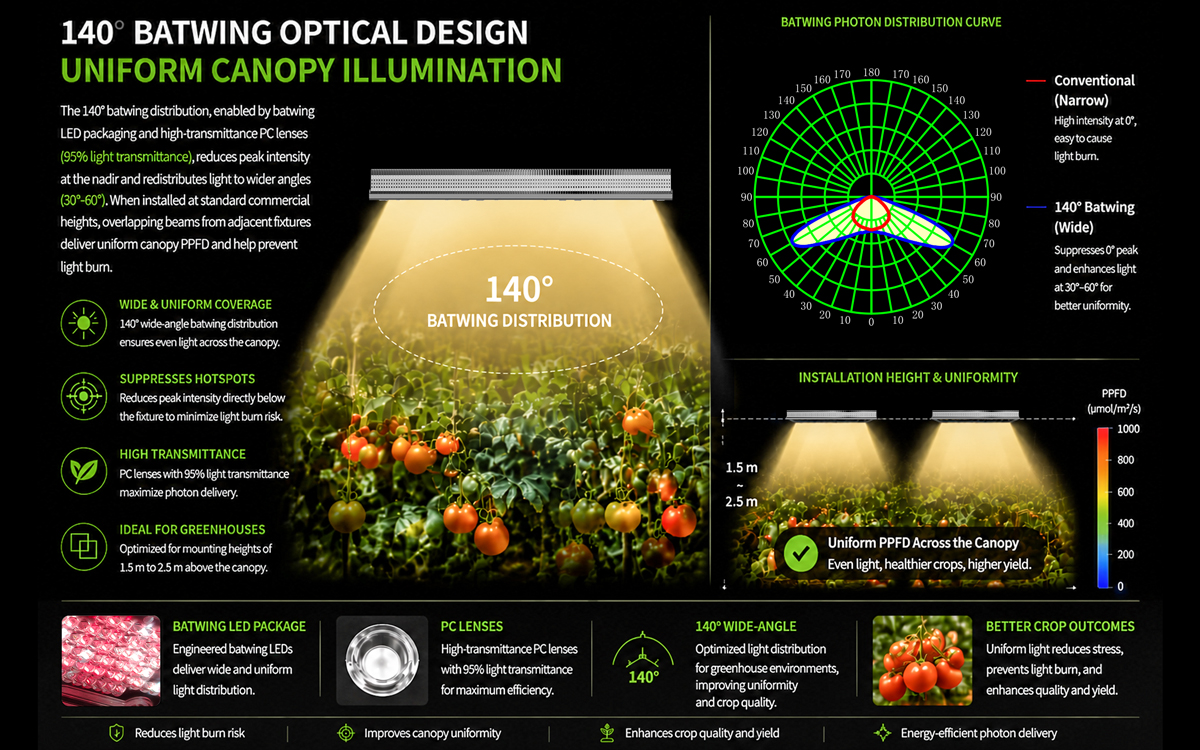
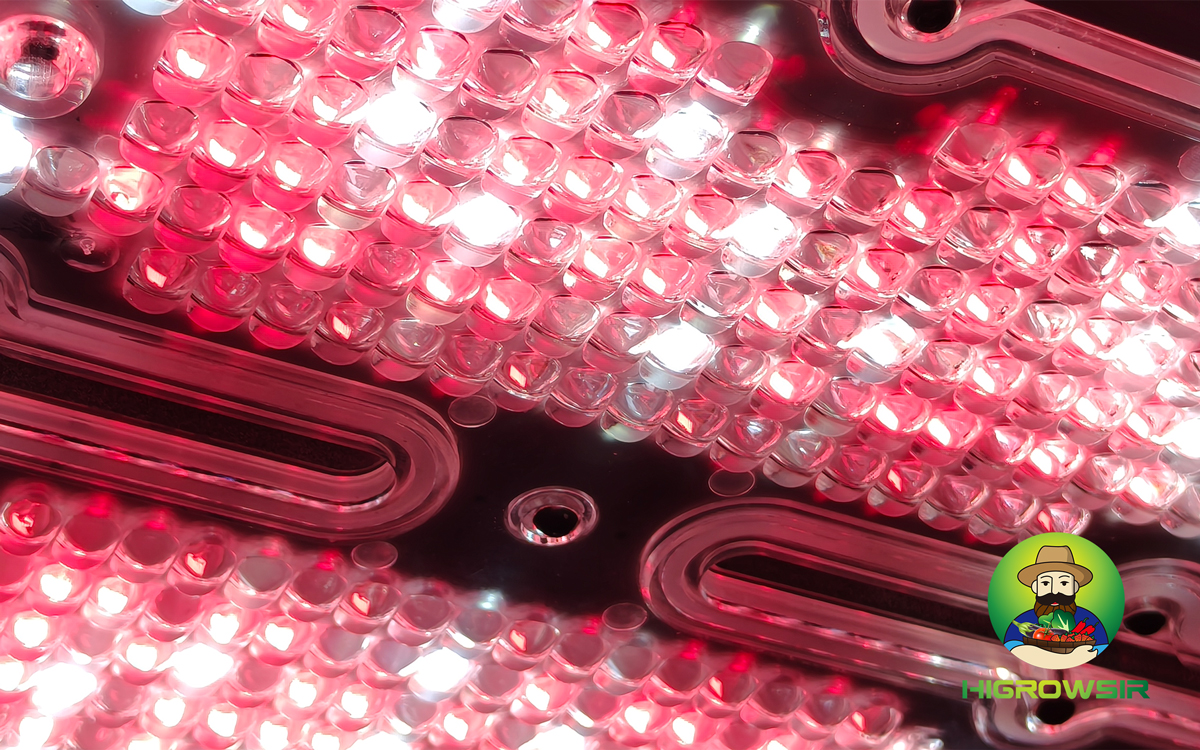
To evaluate photon uniformity, the tested fixtures utilized a 140° wide-angle distribution enabled by batwing-shaped LED packaging, protected by high-transmittance PC lenses with a documented 95% light transmittance.
Optical mapping confirms that the 140° batwing curve suppresses peak intensity at the zero-degree nadir (directly below the lamp) and redistributes the luminous flux toward the wider angles 30° to 60°. When installed at standard commercial heights—matching the 1.5-meter to 2.5米 clearance above the canopy typical of modern Dutch greenhouse designs—the overlapping beams from adjacent fixtures create a uniform canopy illumination profile, effectively mitigating the physical conditions that cause light burn.
Managing the thermodynamic and optical variables of high-power top-lighting is essential for safeguarding large-scale glasshouse investments. The real-world data from HIGROWSIR’s 1500W evaluation demonstrates that stabilizing fixture equilibrium at 70°C and utilizing a 140° batwing distribution provides commercial tomato growers with a reliable blueprint to boost yields while fully mitigating the risks of microclimate disruption and crop photobleaching.
Optimize Your Greenhouse Light Plan
Every commercial glasshouse possesses unique dimensions, structural truss heights, and local climate parameters. HIGROWSIR’s engineering team provides professional, complimentary DIALux light simulations and tailored spectrum consultations for large-scale tomato cultivation across Europe and Eastern Europe.
Welcome to contact our technical experts to evaluate your greenhouse specifications and customize your next-generation lighting layout.
(Note: This complimentary service is reserved exclusively for commercial operators and greenhouse consultants.)

Copyright © 2026 HIGROWSIR LTD All rights reserved. Site Map Powered by